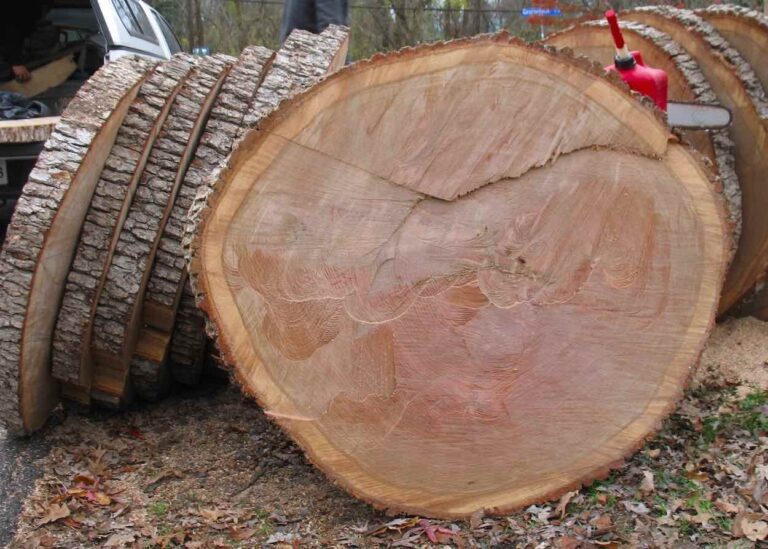
On Sunday, November 15, a two-man crew from East Coast Renovations, LLC in Herndon, engaged by Fairfax County Park Authority, began the process of slicing the large trunk of a fallen white oak tree at the corner of Innsbruck Avenue and Georgetown Pike into “tree cookies.” These cross section slices of the trunk are typically used by the owners, in this case, the Park Authority, to create commemorative plaques that serve as teaching tools to help nurture a love for nature, and are sometimes awarded to non-profit groups such as schools or nature centers.
When the tree is as old as this one that came down two weeks ago, the tree cookies reveal a link to a distant past, covering parts of three centuries, and the history contained therein.
Great Falls Citizens Association is exploring ways to investigate why the community is losing these historic trees. This is the fourth large tree that the Park Authority has seen come down in this manner, with no obviously visible inner damage to their trunk or base. Read more about the oak decline in Northern Virginia here, and steps tree owners can take here.
Tree cookies
Tree cookies are cross section slices of tree trunks that foresters and teachers use to illustrate how trees grow. Tree cookies reveal the many different layers that make up a tree. Each layer can reveal something about the tree’s life and the climate in which it grew.
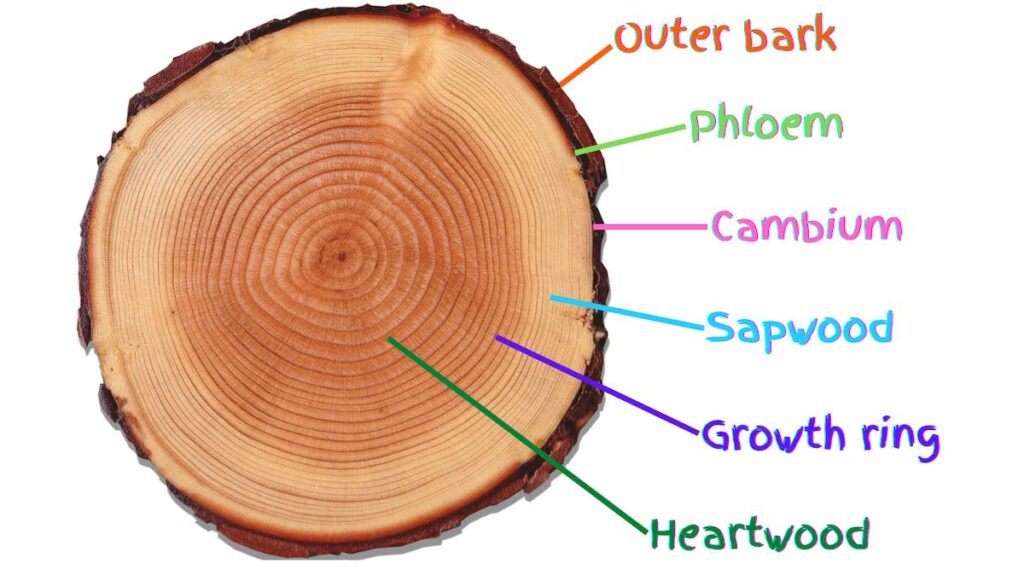
Outer bark – This layer protects a tree from insects and disease, excessive heat and cold and other injuries.
Phloem or inner bark – This layer carries sugar made in the leaves or needles down to the branches trunks and roots, where it is converted into the food the tree needs for growth.
Cambium – The Cambium is a layer or zone of cells, just one cell thick, inside the inner bark. The cambium produces both the xylem and phloem cells. This is where diameter growth occurs, and where rings and inner bark are formed.
Sapwood or xylem – This layer carries the sap (water plus nitrogen and mineral nutrients) back up from the roots to the leaves. Sapwood gives a tree its strength.
Growth ring – The lighter portion is called the “early wood” (because it grows in the spring), and the darker portion the “late wood” (which grows in the summer). Together, they represent one year of growth – yes, one can count the rings to see how old a tree is.
Heartwood – Heartwood develops as a tree gets older. It is old sapwood that no longer carries sap, and gives the trunk support and stiffness. In many kinds of trees, heartwood is a darker color than sapwood, since its water-carrying tubes get clogged up.
Most tree cookies also display darker-colored radial spokes called rays. The rays are plates of living cells that carry materials to and from the outer and inner layers of the tree. As the tree expands through growth, the rays become longer and extend from the cambium to the middle of the tree trunk.
The rings
Year by year, trees grow in diameter by producing new wood in the layer just beneath their bark. When a tree is cut down, the layers are visible in a cross section. The layers appear as a set of concentric circles known as tree rings.
One layer of wood grows each year. Each layer consists of two colors of wood. The light-colored ring is the “springwood” that grows in the spring. The dark-colored ring is the “summerwood” that grows in the summer.
Tree rings vary in width each year depending on the environmental conditions. Tree rings are wider during years of abundant rainfall and narrower during years of drought. Trees also grow faster when they are young and grow slower when they are old.
The rings of a tree give foresters a lot of information about the age of the tree, its health, and the climate conditions during each year of its growth. A tree cookie with many tight rings will indicate that it is from an older tree that grew with more competition. If its center rings are offset, that suggests that the tree either grew on a slope or had to grow around some sort of obstruction.
A tree cookie that has a small number of wide rings indicates that it came from a young tree that grew in an area where it had little competition for the things a tree needs to grow — such as sunlight, water, and nutrients.
Sources: Falls Church, Va. Government; Virginia Pilot; University of Maryland Extension; New York City Soil & Water Conservation District; Idaho Forests Products Commission; DePauw University