The February 25 town hall meeting hosted by the Great Falls Citizens Association provided an opportunity for residents to hear more about VDOT’s plans to replace the existing single-lane bridge on Springvale Road and express their views on the proposed larger two-lane structure. Per Gary Runco, Northern Virginia District Structure and Bridge Engineer / Virginia Department of Transportation (VDOT), the condition of the 22 foot long bridge, constructed in 1932 and rebuilt in 1965, has deteriorated to the point where safety is a concern. While additional timbers, beams and knee braces have been installed, this is only a temporary fix to address the most immediate problems. The bridge will continue to be inspected by VDOT on a routine basis, and barring major unforeseen natural events, the bridge will remain open while VDOT works with the community to reach an agreement, funding is secured, and construction can begin.
The flooding that closes the bridge during heavy rain storms will not be addressed since both VDOT-proposed two-lane designs, i.e. with or without a median, would only be a few inches higher than the existing bridge. VDOT has estimated that the bridge will be closed for approximately six months during construction.
Following opening remarks by GFCA and recognition of Supervisor John Foust and Virginia State Senator Barbara Favola, the floor was turned over to Runco, who summarized VDOT’s interactions with Great Falls Citizens Association (GFCA) and said that a public information meeting on the project is being planned for May 2021.
As summarized by Runco, feedback received from 26 residents showed that 14 are in favor of a one-lane bridge while 12 believe that two lanes are preferable. Should, however, VDOT build a two-lane bridge, there was a slight preference for a median splitter island. Runco noted that, “the bridge is not the issue; the issue is traffic,” and added that “if we [VDOT] built a two-lane bridge but came up [with] traffic calming solutions — stop signs at the Springvale/Brevity intersection or a speed table or speed humps on Springvale Road — we can solve the traffic issues.”
While VDOT can probably postpone replacement of the bridge until Leesburg Pike construction is completed, what VDOT cannot do is make the bridge one-lane based on the federal safety laws, budgets, construction requirements, and rules of physics that govern its decisions. Runco said that while some conditions may warrant a one-lane bridge, a design waiver request, as well as a letter by the county requesting the one-lane bridge, must be approved by the State Structure and Bridge Engineer. He emphasized that such design waivers only can be considered when the design year average daily traffic volume (ADT) is less than or equal to 400 vehicles. The AADT (annual average daily traffic) on Springvale as of 2019 was 4700 vehicles, well above the stated threshold. Click here for the reference at the Virginia Department of Transportation website.
As VDOT Northern Virginia is precluded from authorizing a one-lane bridge, it appears the only option open to the community is to secure the support of Supervisor Foust and the Fairfax County Board of Supervisors and seek a special exception from the State engineer in Richmond.
In response to this information, John Halacy, GFCA Coordinator — Springvale Bridge Working Group, asked the rhetorical question, “It is unclear why a bridge replacement policy that someone in VDOT wrote down in a manual carries more weight in this decision than the residents of Great Falls. If we say that a two-lane bridge on Springvale is wrong, we don’t want it, we don’t want Great Falls to attract ever increasing traffic and safety problems, [and] if that is our consensus, then why is someone in Richmond determining what is best for Great Falls?”
GFCA, whose stated goal is to work to preserve the character of Great Falls, has taken the position that the existing bridge is a gateway to Great Falls and that its current one-lane design serves to limit traffic through the village. It is generally believed by the community that Springvale Road and other roads that link Rt. 7 and Georgetown Pike, including Walker Road which is scheduled to have its one-lane bridge replaced with two lanes, are appealing alternatives for drivers seeking to avoid the high cost of using the Dulles Toll Road between I-495 and Reston/Loudoun. Any such alternative routes are deemed to be detrimental to Great Falls, and the community has continuously worked to protect the semi-rural atmosphere of Great Falls and the historic Georgetown Pike. This designated byway is currently carrying more traffic than it was designed for, bringing with it traffic congestion, speeding, and illegal passing, and creating a significant hardship for residents who live on the Pike.
Findings from a GFCA survey distributed last fall to homeowner associations and residents who would be most affected by the project, i.e. those between Crippen Court and Georgetown Pike, indicate that almost two-thirds of respondents were in favor of a single lane bridge option. Besides the potential for added traffic, sightline limitations at the curve near Brevity, and speed issues, the residents who live directly on Springvale Road foresee having difficulty getting out of their driveways safely.
This view is reinforced by the results of a straw poll held during the February 25th meeting. Of the 52 Great Falls residents who participated in the poll, 48 voted in favor of retaining the one-lane bridge.
Per GFCA President Bill Canis, GFCA has heard inconsistencies in VDOT messages, including the purported impact that increased road capacity would have on traffic and an I-495 NEXT flyer which says that regional improvements will “reduce cut-through traffic on local roads in McLean and Great Falls, increasing safety and returning the local roads to local residents.”
During the question and answer portion of the meeting one resident ventured whether retaining a one-lane bridge would actually make a significant difference in addressing traffic through the Village, speculating that if the choice for drivers traveling between points west (e.g. Loudoun County, Reston) and I-495 is to use Georgetown Pike or Rt. 7, then drivers facing that choice are likely to take the Pike rather than risk encountering heavier traffic congestion at Tysons by using Rt. 7, which is also the longer route. Furthermore, it was theorized that a two-lane bridge might move these drivers onto the main roads quicker, thereby reducing pollution near the bridge. Clarity on these issues could come from a detailed forecast of traffic on Springvale and Walker Roads and address the concerns of Great Falls residents.
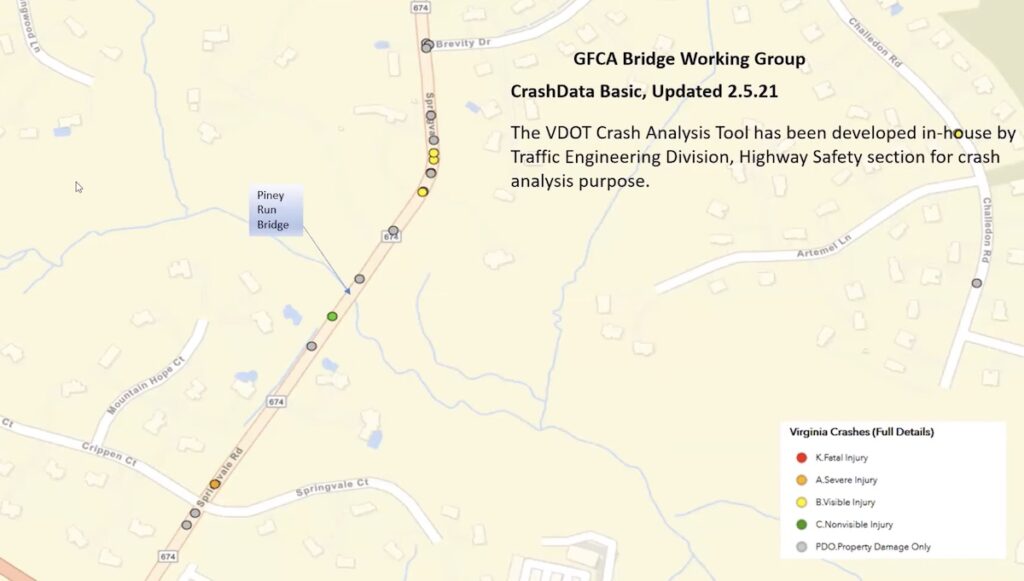
While VDOT has indicated that a two-lane bridge might improve safety and reduce the number of accidents associated with the Springvale Road bridge, GFCA’s findings show that most accidents don’t occur at the bridge, as shown in the illustration below. GFCA believes that the one-lane bridge serves to slow traffic.
Henry Lippincott stated that when he first heard of the community’s one-lane bridges being replaced by two lanes, he thought it was a good idea. However, based on further research that he conducted on five other communities from North Carolina to Connecticut where this has been considered or done, he concluded that it is in the best interest of Great Falls to retain the one-lane bridge on Springvale Road. Lippincott found that in the three communities where two-lane bridges had replaced a one-lane bridge, the change resulted in increased through-traffic, higher speeds, unlawful truck traffic, a loss of community character, and an overall deterioration in quality of life from the resultant suburban sprawl that followed the widening of the bridges.
In response to other issues raised during the Q&A, it was learned that:
- Roads have different levels of service and there are different criteria that are applied for each. Urban arterials, such as Hunter Mill Road, cannot have traffic calming measures, as the roads are designed to improve traffic flow. Springvale Road is a local collector and, as such, traffic calming measures may be feasible if supported by Fairfax County’s Department of Transportation. The community has every right to request multiple traffic calming measures and suggest certain improvements if it wants.
- While Great Falls residents feel that the volume on Georgetown Pike is significant and should be reduced in order to maintain the rural nature of the community, VDOT traffic planners believe that by adding more capacity on I-495 as well as Rt. 7, there will less inclination for drivers to use Georgetown Pike.
- Nothing VDOT does with respect to the bridge replacement will make flooding worse, but there are solutions the designers can provide that will prevent having the bridge itself be damaged by flooding. This means building a higher bridge, which Great Falls residents have previously objected to, because the design would have resulted in a bridge that is 300 feet long and 10 feet higher. It was pointed out that management of flood plains and stream banks rests at the county public works and environmental services level.
- With respect to bridge weight limits, it was noted that Virginia has adopted the AASHTO guidelines for low volume roads, which include geometric designs, in terms of bridge width. AASHTO refers to the American Association of State Highway and Transportation Officials, a standards setting body which publishes specifications, test protocols, and guidelines that are used in highway design and construction through the United States.
- VDOT has engaged consultants to secure data on traffic counts and turning movements.
Residents who have feedback on the proposed bridge replacement project were invited to direct their comments to Gary.Runco@vdot.virginia.gov.