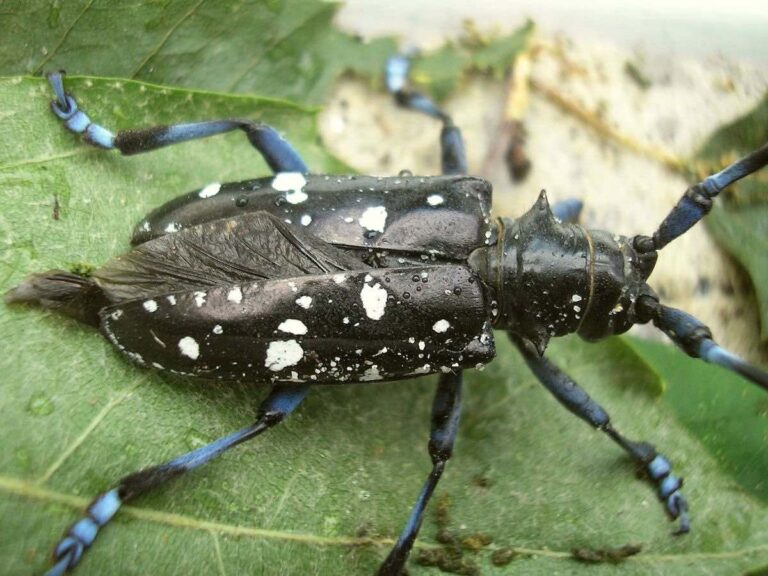
The Asian longhorned beetle, or ABL, is one of the most serious and destructive tree pests to strike North America. This beetle (Anoplophora glabripennis) has blue feet, a black body and white spots on its back. ALB is a threat to many of America’s hardwood trees, especially maples, and has no natural predators in the U.S.
So far, this insect has been found in the New York City metropolitan area, Chicago, two locations in New Jersey, Toronto and most recently, in Worcester, Massachusetts. Asian longhorned beetles to date have not been found in Fairfax County.
A native of China, this wood boring insect was most likely introduced into this country through packing crates. With no natural enemies to keep its populations in control, Asian longhorned beetles have the potential to destroy millions of acres of hardwood forests as well as residential landscape trees. Due to the Asian longhorned beetle’s destructive power, Fairfax County foresters are on the lookout for it. If you have seen this beetle or have possibly seen damage caused by it (see below), please contact the Forest Pest Branch at 703-324-1770, TTY 711, or by email.
With no means of eliminating ALB, early identification and eradication are critical to control its spread.
“Thus far, ALB has been found in the New York City metro area, Chicago, New Jersey, Toronto, Worcester, Mass., and most recently in Hollywood, S.C.,” said Joan Allen, Chief, Forest Pest Branch, Urban Forest Management Division (UFMD), “where it was found by a homeowner who reported it to a state agency,” Allen said.
Normally, this is how ALB is discovered in communities – by alert residents who regularly check trees in their yard or neighborhood – a practice that is recommended by Fairfax County urban foresters.
“We are very aware of this potential threat to the urban forest in Fairfax County and we are alerting the public to keep their eyes peeled for this beetle,” Allen said. “The Fairfax County NewsCenter just updated their public information about ALB, and UFMD and TV 16 collaborated to create a video, which is airing on 16 Around Fairfax and has been posted to YouTube.”
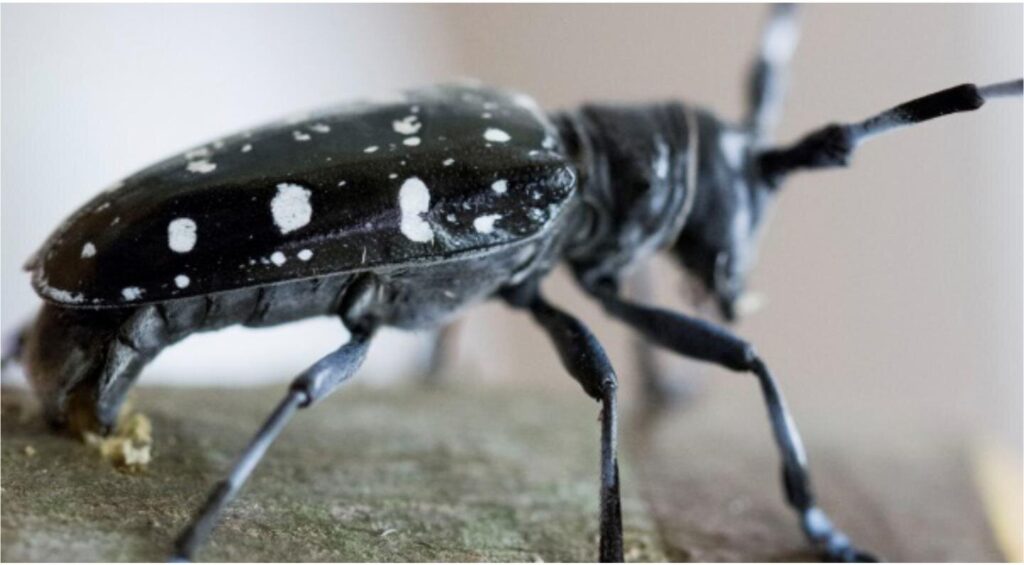
The Asian long-horned beetle is a distinctive-looking insect with these characteristics:
- Body is about 1 inch to 1 inch and a half in length.
- Antennae, longer than the insect’s body, is banded in black and white.
- Shiny jet black body that features random white spots.
- Six legs, in some cases with bluish-colored feet.
Signs of an infestation start to show about three to four years after the tree is infested. Such trees show these signs:
- Dime-sized or smaller round exit holes in the tree trunk or branches.
- Shallow oval or round scars in the bark, where the adult beetle has chewed an egg site.
- Sawdust-like materials, called frass, on the ground around the tree or on the branches.
- Dead branches or limbs falling from an otherwise healthy-looking tree.
USDA Animal and Plant Health Inspection Service reports that maples are the most commonly infested trees in North America. Infested trees do not recover and, therefore, should be removed.
ALB has the potential to destroy millions of acres of hardwood forests and residential landscape trees. The trees most at risk are several types of maples, the American elm, horse chestnut and willow trees and poplar trees, among others. This is a large beetle with adults about 3/4 to 1 ¼ inches long with striped antennae that can be longer than their body. Adults are present from July to October but can be found later in the fall if temperatures are warm. The female beetle usually lays 35 to 90 eggs during her lifetime. The eggs hatch in ten to 15 days. The larvae feed under the bark in the living tissue of the tree and prevent water and nourishment from being absorbed by the tree.
“The larvae then bore deep into the tree where they pupate,” Allen said. The adults emerge by boring a tunnel in the wood and creating a round exit hole about the size of a dime. At that point, the adult Asian longhorned beetle may move on and attack another tree. Once a tree is infested with ALB, it may take several years to notice the signs or symptoms, but the infested tree will harbor more and more insects until the tree dies. “The only effective method that is used to eliminate ALB is to remove infested trees and destroy them by chipping or burning,” she said.
What can county residents do to prevent the spread of the Asian longhorned beetle?
“Check your trees on a regular basis. August is Tree Check Month, and we recommend this practice,” Allen said. When checking trees look for oozing sap, an accumulation of coarse sawdust around the base of trees, and uniformly round holes that are about 3/8th of an inch in diameter on the trunk or branches. Also, it is recommended that you should not move firewood from one location to another.
If a resident sees an Asian longhorned beetle, they should try to capture it in a jar or a plastic bag and store it in the freezer. Take its picture and email the picture and the location where the beetle was found to pestmail@fairfaxcounty.gov or report your finding by calling the Urban Forester of the Day at 703-324-1770, TTY 711.
Source: Fairfax County Public Works and Environmental Services