- The Zoning Administration Division of Fairfax County is preparing to propose changes to the current Zoning Ordinance that would establish a provision for a new category of land use in the County termed agritourism.
- Its purpose is to create a smooth mechanism for approval and regulation of activities that would be consistent with agritourism uses as that term is applied in other regions. In Virginia, agritourism is defined by the Commonwealth, not the municipalities.
- However, although the County may not regulate agritourism activities per se, evaluating an applicant’s proposed activities to determine the impact on health, safety, or general welfare falls within the purview of the County’s Zoning Administration staff.
- The proposal that is expected to be considered by the County will include language that would describe that, absent a negative impact, the Fairfax County property owner applicant would receive approval by-right, subject to other regulations, rather than by specific approval of the County staff.
- Great Falls Citizens Association has passed a resolution expressing its concerns with the upcoming proposal to change the Zoning Ordinance to permit agritourism applicants on a by-right basis. It is thought that the Great Falls community, more than other parts of the County, contains many property owners who could take advantage of the ordinance, causing increased development with a rise in traffic, safety concerns, noise, and environmental damage.
The proposal from Fairfax County’s Zoning Administration Division regarding agritourism and the feedback from citizens has shed light on the rapidly changing landscape of Fairfax County. Over the years, the County has presented itself as a hub for new businesses and new development. It is now situated as an ever-urbanizing powerhouse, inviting everyone from all over the world to live, work, and raise a family. At a time when rural preservation and urbanization collide, residential communities and the protection of their neighborhoods are taking center-stage.
Section 3.2-6400 of the Code of Virginia defines agritourism activity as “any activity carried out on a farm or ranch that allows members of the general public, for recreational, entertainment, or educational purposes, to view or enjoy rural activities, including farming, wineries, ranching, historical, cultural, harvest-your-own activities, or natural activities and attractions.”
The Code goes on to state that no locality is allowed to regulate agritourism activities unless there is a substantial impact on the health, safety, or general welfare. However, the Code does not identify any criteria by which to measure those impacts. It is the use determination process that allows the Zoning Administration staff to determine if the proposed use has a substantial impact on the health, safety or general welfare of the community. If there is such an impact, Special Permit or Special Exception approval may be required, depending on the type of agritourism use.
Therefore, the Zoning Administrator has had to determine on a case-by-case basis whether such activity has a substantial impact on the health, safety, or general welfare of the public. Setting thresholds in the Zoning Ordinance will provide a predictable and consistent path for future agritourism activities in Fairfax County.
The following activities and similar uses are under consideration to be permitted by right as an agritourism use in conjunction with agriculture:
- Farm tours, including educational programs, workshops, or demonstrations related to agriculture
- Harvest-your-own activities
- Walking, equestrian trails, and other similar passive recreational activities
- Seasonal Festivals
- Special Events such as weddings and corporate events
Due to the potential substantial impact these activities can have on health, safety, and general welfare, County staff is considering a tiered approach with use limitations. Agritourism uses are proposed to be allowed by-right when the use limitations in Table 1 below are met. If an agritourism provider wishes to exceed the limitations in Table 1, it could do so by special exception approval.
In creating the tiered approach, County staff applied the acreage and number of attendees currently permitted under farm wineries to the Tier 3 agritourism category; however, the County does not propose to distinguish the number of attendees based on the road type, as agricultural operations can be located on a variety of road types and engaging in agritourism activities of varying intensity.
Farm wineries, limited distilleries, and limited breweries are separately defined, and no changes are proposed to the existing special exception standards and their ability to host events for those uses, except for possibly removing the road classification requirement to correspond with this proposal. By limiting the total number of visitors in a day, the number of vehicle trips and impact to the adjacent roadways would be limited.
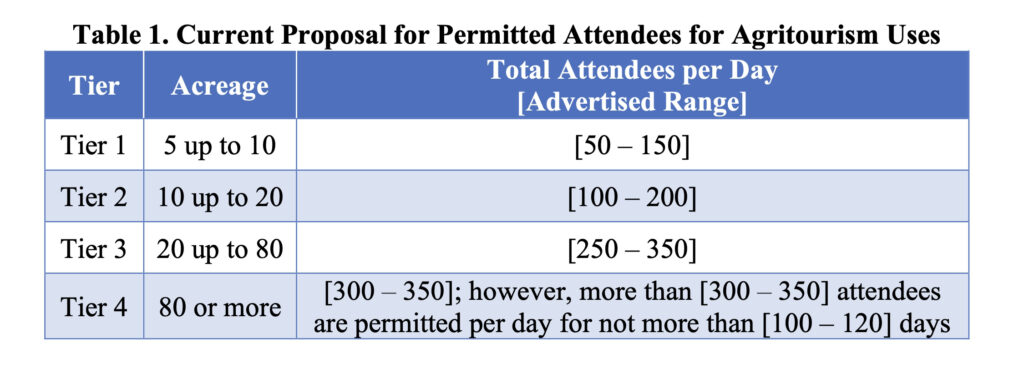
With respect to Tier 4, County staff is proposing a range of attendees for the public and the Board of Supervisors to consider but will be recommending a specific maximum number of attendees to the Board when the final report is published.
In addition to the foregoing agritourism activities, this amendment would also establish the following provisions related to agritourism:
- Permit food trucks in association with an agritourism use, with limitations on the number and duration.
- On parcels 80 acres or larger, permit expanded retail sales, including modifying the 400-square- foot size limits and location requirements for wayside stands.
One additional significant change proposed by County staff is to permit Bed and Breakfasts by-right (instead of requiring a special exception) in the R-A through R-1 districts on a parcel of 20 acres or more. This by-right permit on such properties applies to conditions where the B&B is located in a single-family detached dwelling, and contains additional use limitations on parking and restrictions of events hosted on-site.
At earlier town-hall meetings, County residents have expressed several significant areas of concern. Many feared the proposed amendment would lead to an increase in development in their neighborhoods. They also voiced concerns about a possible influx of people, traffic, safety, noise, and the potential negative impacts on the environment. Community members have also voiced concerns over not only increased density in their neighborhoods but the lack of enforcement that could result in the proposed complaint-based system.
The executive board of Great Falls Citizens Association (GFCA) has passed a resolution expressing its apprehensions about any proposed change to the recently revised Zoning Ordinance that would establish a provision for this new category of land use (agritourism). GFCA’s Land Use & Zoning Committee has had this proposed activity on its radar since 2019, and several areas of concern have been forwarded to County staff. Because of the zoning of Great Falls, there are numerous property owners who could take advantage of this ordinance.
Hearing dates on the County staff’s proposal have been published as follows:
- Planning Commission public hearing: May 12, 2021 at 7:30 p.m.
- Board of Supervisors’ public hearing: June 8, 2021 at 4:00 p.m.