A special report from Great Falls Citizens Association
By Jennifer Falcone, Chair, Land Use & Zoning Committee (LUZ), Great Falls Citizens Association (GFCA) and Peter Falcone, member LUZ
GFCA’s Land Use and Zoning Committee (LUZ) has undertaken numerous important issues in the past year impacting Land Use and Zoning in our community, and as 2021 has drawn to a close, several of those more challenging issues remain at the forefront of the committee’s 2022 agenda. The prospect of the continuation of a strong housing market in 2022, due to low mortgage rates and a low inventory of available housing, will likely fuel the demand for new residential construction, including in-fill and “by-right” development within larger lots in Great Falls. This growth continues despite the turbulence and staggering effects of the COVID pandemic
Residential and commercial expansion has continued in Northern Virginia at an alarming rate. For example, on one day in December 2021 (12/08/2021) more than 60 building permits were filed with Fairfax County for projects valued at more than $14M in total. This staggering number is just a glimpse into the volume of development and change occurring across the spectrum of residential and commercial activity taking place in the County.
Over the past year, we have observed how this frenzied pace has played out in our community and how standards and regulatory guidelines are being pushed to the limits. One organization, LandScope America (www.LandScope.org), an online resource for the land-protection community and the public that was a collaborative project of NatureServe and the National Geographic Society, describes this phenomenon as development pressure. According to this organization’s perspective, decades of poorly planned commercial and residential development have taken a huge toll on the quality of both our lives and the natural environment.
LUZ is concerned that the unintended effects of intensifying the uses of land and increasing the density in suburban areas like Great Falls could have undesirable consequences down the line.
GFCA is aware that increasing development in Northern Virginia and the Washington metropolitan area is also leading to longer commuting times with people traveling greater distances to the workplace. Although the Pandemic has led to a slight reduction in highway traffic with more teleworking options becoming available, historically, D.C. area commuting times rank in the top five cities nationwide, according to NPR-station WAMU. However, the net effect is increased traffic congestion, as well as air and water pollution. Regrettably, more roads and the creation of impermeable hardscapes increase storm run-off, diminish water quality, and reduce options for outdoor recreation. Interestingly, LandScope believes that “…in creating the infrastructure — the buildings, roads, sewers, and water systems — required to accommodate and support such patterns has had the unintended effect of allocating public resources to diminish the public’s health and well-being.” They have considered that the effects of decades of “poorly planned commercial and residential development … have taken a huge toll on the quality of both our lives and the natural environment.” Finally, and what seems most relevant to the future of Great Falls is, they conclude, and we agree, that even at low densities, poorly planned development can fragment natural habitats, greatly reducing the value of remaining open spaces for biodiversity, recreation, and other uses.
In-fill and New Residential Construction
Against a backdrop of this growth and development, Fairfax County’s Comprehensive Plan contemplates the effects this expansion within the County and the diminishing supply of vacant land. The language of the Plan predicts that if current trends continue, the supply of land presently planned for residential development will be all but exhausted shortly after the turn of the century. Yet, this caution seems unheeded in the County as few, if any, plans are rejected. A major concern going forward is more pressure being placed on communities like Great Falls by County officials to support those who seek changes in zoning restrictions by way of Special Exceptions and Special Permits, or even zoning amendments in a process referred to as “up-zoning.” Up-zoning is a change in zoning regulations that permits increased capacity for development. GFCA will remain vigilant in this area in 2022 and beyond.
Nevertheless, the Comprehensive Plan’s predicted land shortage has implications not only for the residential development pattern that may emerge, but also for existing residential development. It also envisions that as land values increase due to decreasing supply, the pressure to redevelop existing lower density neighborhoods, as well as nonresidential acreage, will increase (see up-zoning above). Evidence of this pattern can be found in our neighboring County of Arlington and in parts of Fairfax County. Neighborhoods that once consisted of cottage-like Cape Cod style houses are gradually transforming as those properties are razed and replaced by larger homes, and in some cases representing more intensive use. Also, larger lots are being subdivided and contribute to increased density. Residents of Great Falls are now experiencing this effect, notwithstanding the way the Comprehensive Plan characterizes this community.
Finally, the planning objectives of the Comprehensive Plan refer to much of Great Falls as developed and planned to maintain very low-density character through large-lot residential development. However, as anyone who travels through the community will quickly observe, these days, land is being offered for development and land clearing activities are underway.
In 2021, LUZ continued to address issues with the controversial 52-acre Rivermont subdivision. A great deal of the GFCA’s focus was on the developer’s failure to adhere to the proffers and development conditions and concerns over site development patterns that culminated in significant problems in controlling large scale runoff from the site to nearby Walker Lake. GFCA also noted infrequent County inspections following periods of heavy rainfall. Surprisingly, GFCA found the absence of a county record of non-compliance by the developer, despite numerous code violations reported by neighbors.
Marmota Farm Development
However, the watershed event of 2021 was the transfer of ownership to Toll Brothers of the historic Marmota Farm, a 22-acre tract at 9800 Georgetown Pike. In 2021, efforts began in earnest to develop eleven homes on the site bordering the Innsbruck community and the Fairfax County Park Authority’s Grange and Old Forestville Schoolhouse, both of which are listed on the National Register of Historic Places.
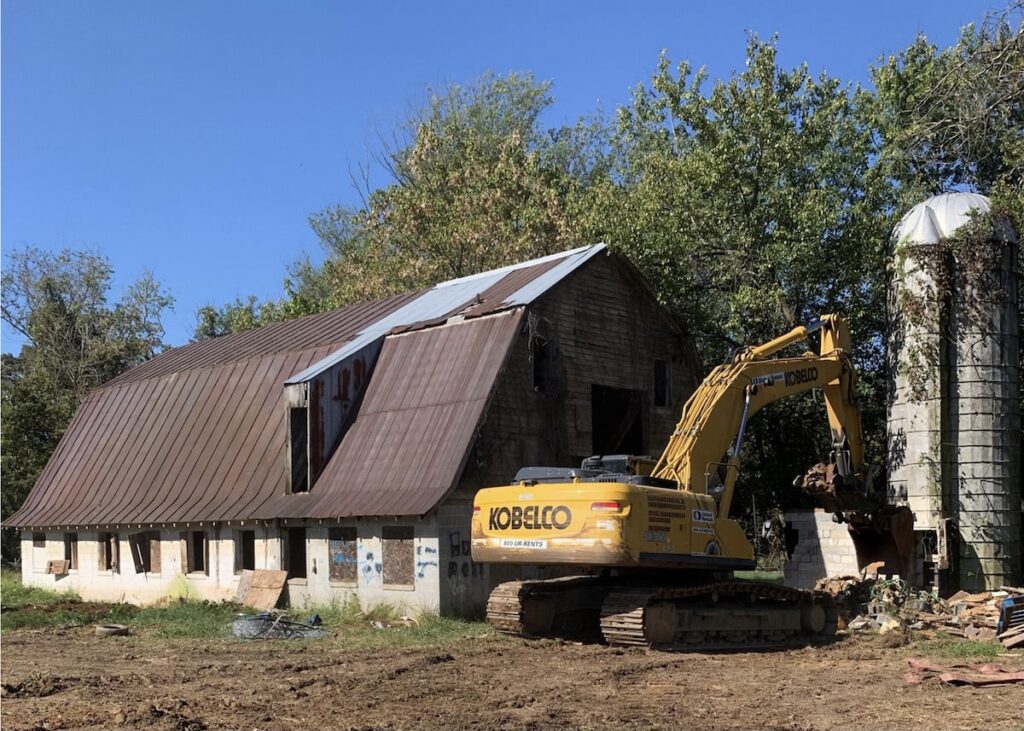
GFCA and the surrounding community engaged throughout the year to address several significant concerns related to that development: its status as a “by-right Development” and its approved “grandfathered” stormwater management standards. The plan for development of Marmota Farm was approved by Fairfax County Land Use officials in 2006. Nevertheless, through persistent efforts by GFCA, the stormwater management calculations were reviewed and changes were made to the site plan as well as the new roadway entrance connecting the development to the historic Georgetown Pike.
GFCA also took issue with the development’s impact on Georgetown Pike and its scenic viewshed. The site’s frontage is on Georgetown Pike, an historic roadway listed on the National Register of Historic Places and designated as the Commonwealth’s first scenic byway. Finally, GFCA engaged with State and County officials to seek preservation of trees on the site and launched a vigorous and ongoing effort to preserve a large Southern Red Oak on the Georgetown Pike right-of-way. In that process, GFCA retained two independent arborists who challenged the conclusions of the County’s urban forester who called for the tree’s removal.
VDOT has maintained that the tree is in their right-of-way and the county’s opinion will not determine its fate. As of this writing the tree remains standing, and GFCA has recommended that VDOT make a final determination this spring when it will be easier to assess if any damage has been done during the installation of a nearby public water line.
Cornwell Farm Manor House
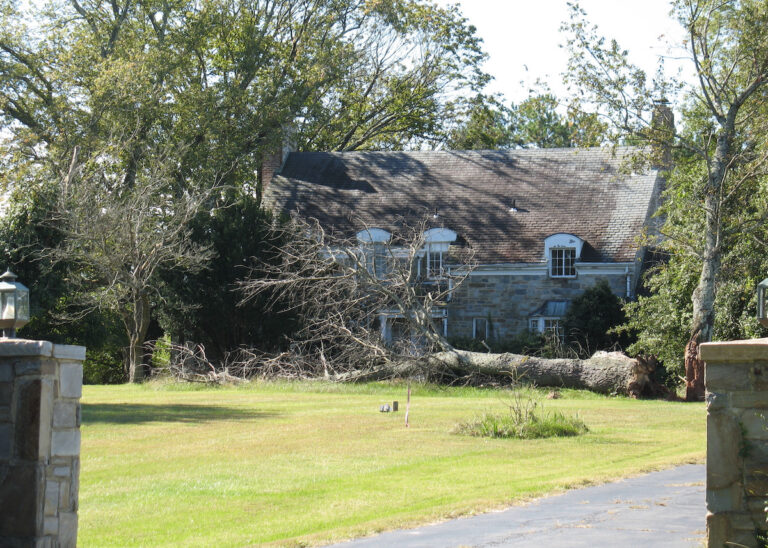
Another project currently in development involves a significant historic residence known as the Cornwell Farm. This nineteenth century manor house named to the National Register of Historic Places in the 1970’s now sits amid land clearing activity and site development.
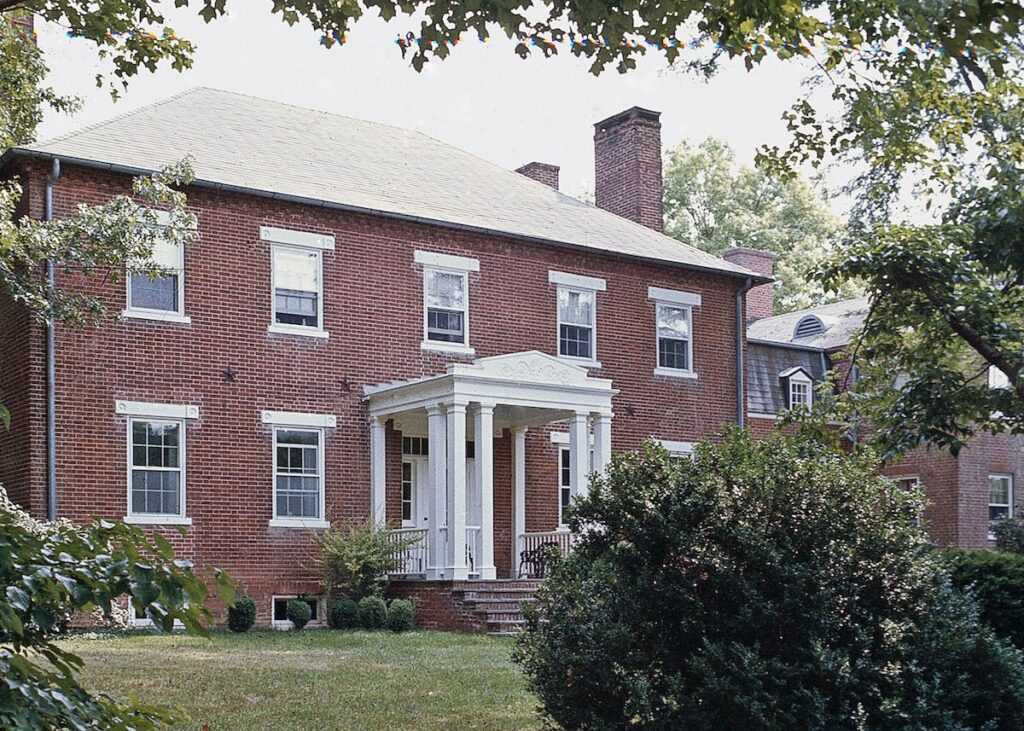
Adjacent to what was formerly open land for grazing horses and separated from Georgetown Pike by once characteristic horse fence and mature pines, the circa 1831 mansion will soon be surrounded by homes situated on two-acre building lots. Preservationists are concerned over the effects this might have on this heritage resource and the resulting transformation of the eight-acre parcel. Click here to read more in The Washington Post.
Exterior Lighting on Hortense Place Subdivision
The recently constructed Hortense Place subdivision prompted a series of meetings in 2021 between GFCA and its developers following their planned installation of non-conforming brick columns along the Georgetown Pike frontage and an accompanying proposal to add 22 non-compliant exterior light fixtures to be constructed on those columns.
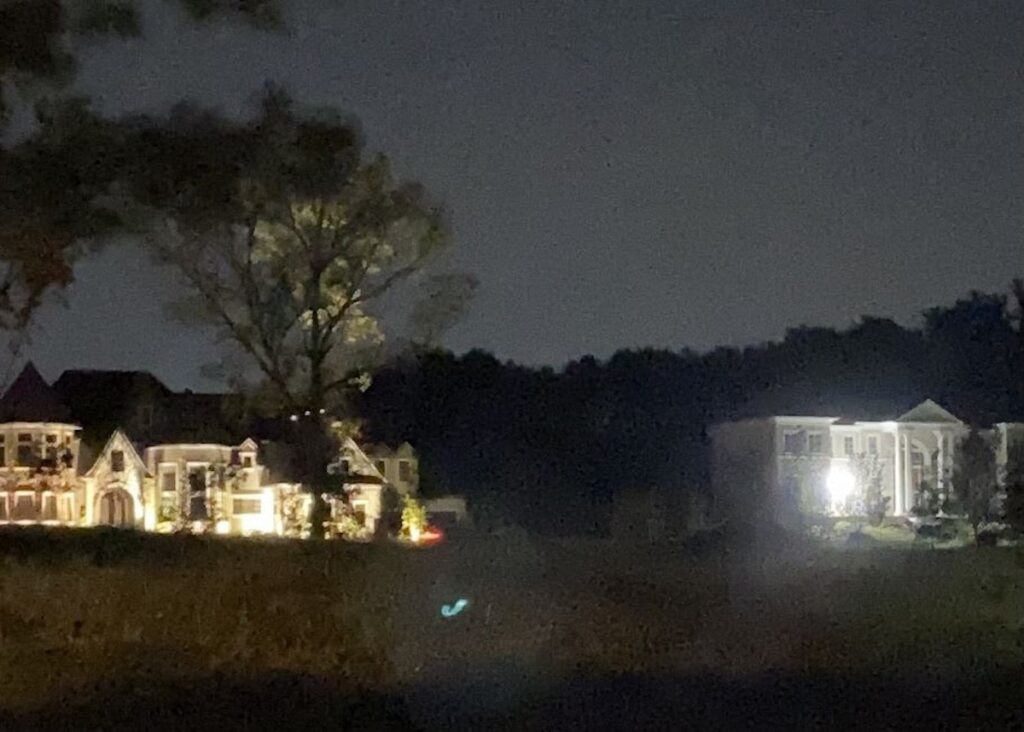
GFCA engaged with the property owners to inquire about plans and advise that this additional proposed lighting on the trail outside of the subdivision could interfere with the nearby Turner Farm Park Observatory activities as well as affect driver vision along Georgetown Pike after dark.
GFCA provided the Hortense Place residents with the sources of information on County exterior lighting standards and objectives related to the preservation of the scenic nature of the historic Georgetown Pike. However, the developer’s plans to use landscape lighting and up-lighting of trees with non-compliant LED fixtures, as well as illuminating building facades with artificial lighting, is not unique to this subdivision. It is a growing trend that is, regrettably, difficult for County staff to oversee as they must rely on citizen complaints, in most cases, to initiate their compliance investigations due to resource constraints.
Other significant land use action involved a LUZ investigation of issues raised by the Addicott Hills Homeowners Association (HOA) concerning a Special Permit Application at 815 Walker Road to accommodate an institutional use for a convent/monastery/nunnery.
815 Walker Road
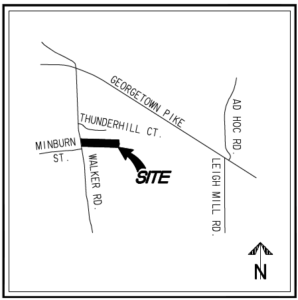
This effort resulted in an unprecedented action by GFCA to join an appeal application before the County’s Board of Zoning Appeals (BZA) to challenge the Zoning Administrator’s Use Determination that described the project as a “convent” although its proposed residents would not be members of an enclosed religious order who have taken solemn religious vows. The BZA decision on this application was made on the day before the July 1, 2021 effective date of the zMod Amendment to the Zoning Ordinance. This amendment set new parameters for describing a convent, placing it within a use category of Religious Group Living. Significantly, it also added new terms which specify that a convent is “…a residence for persons under religious vows, such as a convent or monastery.”
Although the Board of Zoning Appeals approved the Special Permit, the HOA and GFCA believe there exist several procedural and substantive grounds that establish a basis for the appeal and rejection of that Use Determination and the possible revocation of the permit to proceed with building a 14,500-square foot dormitory to accommodate twelve occupants. The application for appeal was accepted by the BZA on January 5, 2022.
Site work began for a 62-unit IntegraCare assisted living facility on Walker Road, across from Dante Ristorante. GFCA Land Use and County staff worked closely with homeowners, Fairfax County, VDOT, and the sponsor (IntegraCare) to ensure that site development would be compatible with the character of the area and tree preservation, and that stormwater controls would be effective.
Also, on the horizon for 2022, a Brightview Senior Living facility was proposed for the current site of Wolftrap Nursery on Leesburg Pike. This project, in the works for three years, but paused due to COVID, was reactivated in 2021. It is in an existing R-1 zone and is being proposed to be a planned continuing care facility to accommodate 172 residents. It would be situated adjacent to two R-2 zones to the south and an R-1 to the East. LUZ has already held several public meetings on this parcel to hear from the developer and nearby residents.
Three additional residential subdivisions begun in 2021 are currently in various stages — from planning to groundbreaking — along the historic Georgetown Pike. All of these subdivisions will likely impact its historic viewshed. Because of subdivision requirements, land clearing and site development will involve removal of trees and natural vegetation along the Pike’s “summer roads” that comprise the shoulder area of the roadway.
These summer roads are described in the National Register of Historic Places designation as the “…original fifteen-foot unpaved summer roads for foot and horse traffic, included in Fairfax County at either side of the Pike where practicable, were used well into the twentieth century and are still identifiable.”
Zoning Administration
A landmark Land Use and Zoning event of 2021 was the implementation of the County’s revised Zoning Ordinance which became effective on July 1, 2021. This project, known as zMOD, was the result of a multi-year process of outreach and review by County zoning staff to modernize the Zoning Ordinance which hadn’t been subjected to a major overhaul since 1978. GFCA’s Land Use Chair participated in the zMOD Citizens Advisory Group and offered many constructive criticisms and recommendations, opposing many of the controversial changes that were suggested by the County’s consultant.
One community group in Fairfax County described the zMod Amendment as 700 pages without an index covering hundreds of complicated topics. A major criticism of the ordinance amendment that carried over from the zMOD Citizens Advisory Group was a concern raised by GFCA that the revisions expanded it beyond its initial scope and, in several cases, eliminated the element of requiring public hearings for certain permits. The expansion of “administrative decisions,” considered by County officials as streamlining now replaces the public hearing process in many instances. This streamlining has the undesirable effect of limiting resident participation in the land use process.
Despite harsh criticism and the objections of residents, community groups, and associations throughout Fairfax County, proposals were adopted by the Board of Supervisors that eliminated the public’s role in the permitting process involving two of the more controversial elements: Home-based businesses and Accessory Living Units (ALUs), previously known as Accessory Dwelling Units (ADUs).
GFCA also joined with community groups and individuals across the County to raise objections to a proposal to modify the display of flags in the planned Zoning Ordinance Amendment. The core objections were that no restriction should be placed on the display of the United States Flag. That provision was ultimately revised.
Also, a controversial agritourism zoning amendment followed closely on the heels of the zoning ordinance rewrite in 2021. It now permits certain nonresidential uses to be conducted on lands on which agricultural activities are taking place. As with the previous zMOD revisions, GFCA and other organizations throughout the County objected to the removal of public hearings from the agritourism application process and the absence of safety requirements for such buildings; a resolution to that effect was submitted to the Board of Supervisors by GFCA’s Executive Board.
Environmental Issues Affecting Land Use
Sensing the effects of development pressure in the community, in early 2021, GFCA submitted comments to Fairfax County’s Environmental Quality Advisory Council (EQAC), noting several key areas of concern. Foremost among them was recognition of the increasing pressure of development and its impact on the community. GFCA stressed the importance of maintaining balance between development and environmental protection and called for several other actions including a review of stormwater management oversight policies, measurement of the impact of land development on preservation of our tree canopy, and a strengthening of the review of development site plans.
In the past year, LUZ heard from residents concerned over land clearing associated with site development and the adverse effects it can have on adjoining properties and the environment and habitat. The most frequent complaint is related to the practice now universally followed by developers to remove as many trees as the regulations now permit and include small scale trees in the final landscaping plan to be approved by the County. Removing the trees and exposing the clay below the topsoil typically results in increased stormwater runoff to neighboring properties. In one case in 2021, GFCA intervened after a neighbor reported that a developer had completely changed the topography of the site, without obtaining a County-approved grading plan, by bringing in fill dirt to illegally raise the site elevation. In another case, a homeowner began clearing all trees on an existing homesite without County approval and, in doing so, intruded into Resource Protection areas that exist on the property. GFCA arranged for County inspectors to promptly visit the site and prevent disturbance of these delicate environmental areas which are integral to the Nichol Run and Pond Branch watersheds in Great Falls.
Finally, GFCA reiterated its support for the implementation of a Dark Sky Preserve surrounding the County’s observatory in Great Falls and for Fairfax County to step up its oversight of outdoor lighting requirements. In that regard, a potential change to the County’s outdoor lighting ordinance was discussed at the October 14, 2021 LUZ meeting. The proposed changes would provide additional measures to protect the observatory at Turner Farm Park. This action arises from a 2020 proposal made by GFCA to the Planning Commission to seek a zoning amendment, authorized by Virginia law, to help safeguard the night skies in the vicinity of the Great Falls Observatory. In that connection, zoning staff presented an update on their work to LUZ.
The Way Forward
The pace of change in the community that is occurring, as suggested by the events described herein, has considerable momentum. The influence of developers and their well-financed support systems means that civic organizations like GFCA must prepare for a long battle if we have any hope of preserving the unique character of our community and the preservation of its natural and heritage resources. Community participation is required at every level.
Moreover, perhaps we can add to the County’s statements at the close of 2021 — that inspection and oversight underline the importance of achieving a workable balance of the need to care for the community and respond to the demands of the land development industry.
Careful planning and recognition of the Comprehensive Plan can help bring about equity and the balance of these competing needs. So, in looking ahead, GFCA will continue its voluntary efforts in 2022 to monitor land use and zoning issues as well as advocate for smart growth while protecting our community’s critically important resources.
The Great Falls Citizens Association is an all-volunteer, non-profit, 501(c)4 organization that advocates solutions and government actions that benefit Great Falls. Its goal is to preserve the semi-rural character of the community while addressing practical concerns like traffic, zoning, retail, schools, parks and the environment where problems arise and solutions must be found.
If you are concerned about any of the issues mentioned in this special report, we’d like to hear from you. Membership in GFCA is open to all Great Falls residents. Please join us. For more info, contact zoning@GFCA.org.