Currently, there is no vaccine to prevent infection with the virus that causes Covid-19, but several pharmaceutical companies, governments and other agencies are working hard to create one, given the urgency of this pandemic.
Planning is underway at the federal, state and local levels to order, distribute and administer a safe and effective vaccine as soon as it becomes available. The Fairfax County Health Department is working with the Virginia Department of Health to develop these plans for our health district.
While vaccine development can take time, researchers are not starting from scratch to develop a Covid-19 vaccine. Past research in other types of coronaviruses has identified potential approaches, some of which have been used before to create vaccines. Together with funding from the government and global coordination, companies have been able to expedite the process by running the vaccine clinical trial phases in parallel with the manufacturing process, without compromising on safety.
Safe and Effective Vaccines
Only those vaccine candidates that are deemed to safe and effective will be approved for distribution to the general public.
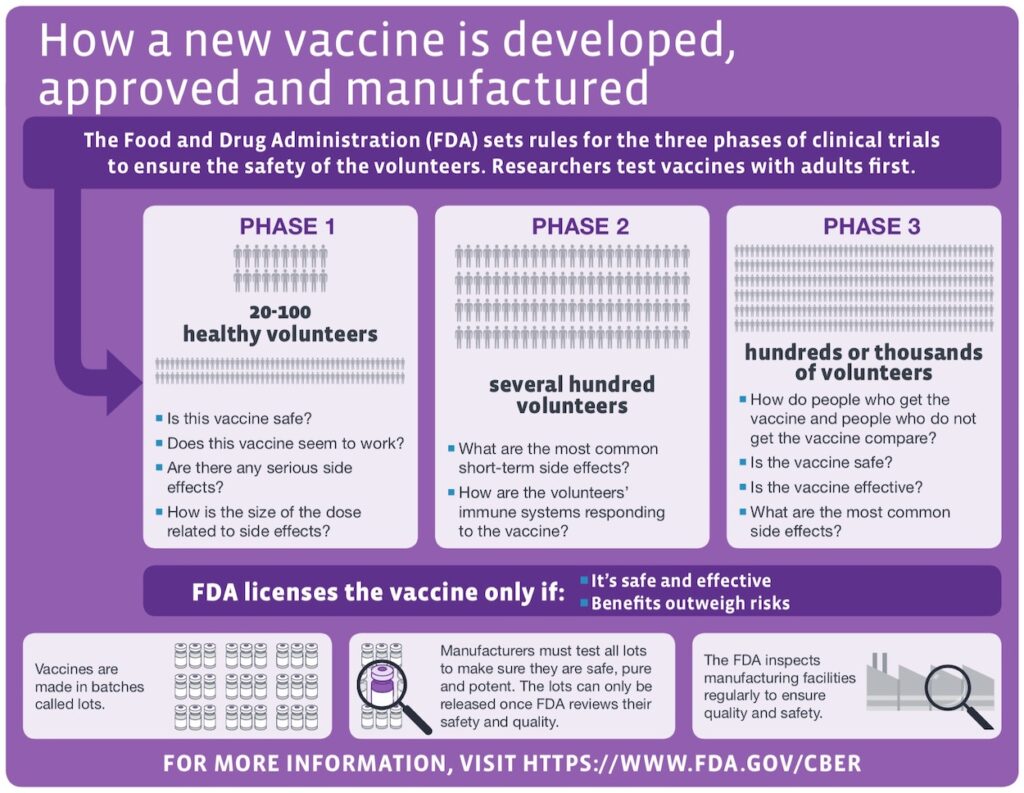
Before a vaccine is ever given to people, the U.S. Food and Drug Administration (FDA) requires extensive testing of the vaccine to make sure it is safe and effective. Here is the process:
- First, a vaccine is tested in animals to see if it works and is safe. If it is, next comes testing in humans. Small phase I clinical trials evaluate the safety of the vaccine in humans.
- During phase II, the formulation and doses of the vaccine are established, and safety is assessed in a larger number of people.
- Finally, during phase III trials, the vaccine’s safety and efficacy (the ability of the vaccine to protect people from infection) are studied in a larger group of people.
The results of these clinical trials on safety and efficacy are carefully analyzed by highly trained FDA scientists and doctors. FDA also oversees the manufacturing process and monitors for any potential safety concerns after the vaccine is in use.
Possible Side Effects
Vaccines can cause side effects such as pain and redness at injection site or less often, a low-grade fever. These reactions usually go away within a few days on their own. More than half of those receiving early Covid-19 vaccines reported mild, short-term side effects such as fever, headaches, muscle aches, and injection-site reactions.
As more people are enrolled in Phase III trials, the safety and efficacy profile of Covid-19 vaccines will be better understood. When millions of people receive a vaccine, less common side effects that were not identified earlier may show up. These are carefully investigated to see whether they may have been caused by the vaccine.
Current Vaccine Status
As of September 2020, there were roughly 40 vaccines against Covid-19 in human clinical trials and more than 90 in laboratory or animal studies. Several candidate vaccines are in large-scale efficacy testing (Phase III), but none has yet completed this phase.
Because Covid-19 continues to kill thousands of people each week, it is important that a safe and effective vaccine be available quickly after a thorough review of the scientific data. Regulatory agencies commonly have special emergency provisions that permit this type of expedited process, and they are encouraged to use them in situations like pandemic influenza and other emergency scenarios. The FDA calls this “Emergency Use Authorization” (EUA), and it weighs the known evidence of risks and benefits with the need to move expeditiously to save lives. EUA will likely be the mechanism that FDA uses to approve a Covid-19 vaccine.
Even after a vaccine is approved, it will take time to produce, distribute and administer to the entire U.S. population. Since the vaccine will be limited at first, plans are being made to ensure it is distributed equitably and to those who most need it, based on Centers for Disease Control and Prevention guidelines. The groups to get the vaccine earliest once it becomes available include people who are essential to provide healthcare to others and those at highest risk for Covid-19 infection, persons with chronic medical conditions and the elderly.
As more vaccine is produced, additional groups will be added, ultimately leading to enough vaccine for everyone who wants to be vaccinated.
A vaccine to prevent Covid-19 is the best hope for ending the pandemic. However, until the date a Covid-19 vaccine is available and even beyond, infection prevention and community mitigation measures will continue to be critical. People will still need to:
- Maintain social distancing of at least six feet and avoid large events and gatherings.
- Wear cloth face coverings in public places.
- Practice good hand washing, at least 20 seconds with soap and water or an alcohol-based hand sanitizer.
- Stay home if sick or if exposed to someone who has Covid-19.
Stay Informed
Call the Fairfax County Health Department Call Center at 703-267-3511 with coronavirus questions; open 9:00 a.m. to 7:00 p.m. weekdays and 9:30 a.m. to 5:00 p.m. on weekends.
Text FFXCovid to 888777 to receive updates from Fairfax County about Covid-19; text FFXCovidESP to 888777 for updates in Spanish.
Email questions or concerns to ffxcovid@fairfaxcounty.gov . This email account will be staffed Monday through Friday, 8:00 a.m. through 6:00 p.m.
Visit the Fairfax County Covid-19 web portal that serves as a one-stop online resource for information.
Learn more about Covid-19 on the Health Department Coronavirus (Covid-19) Webpage or FAQ page.
Follow the Fairfax County Government Facebook Page and Health Department Facebook Page.
Follow @fairfaxcounty and @fairfaxhealth on Twitter.
Source: Fairfax County Emergency Information